
Hey there! As a supplier of banbury mixers, I often get asked about the mixing principle of these awesome machines. So, I thought I'd take some time to break it down for you in a way that's easy to understand.
First off, let's talk about what a banbury mixer is. It's a type of internal mixer that's commonly used in the rubber and plastics industries. Its main job is to mix various raw materials together to create a homogeneous compound. These raw materials can include rubber polymers, fillers, plasticizers, and various additives.
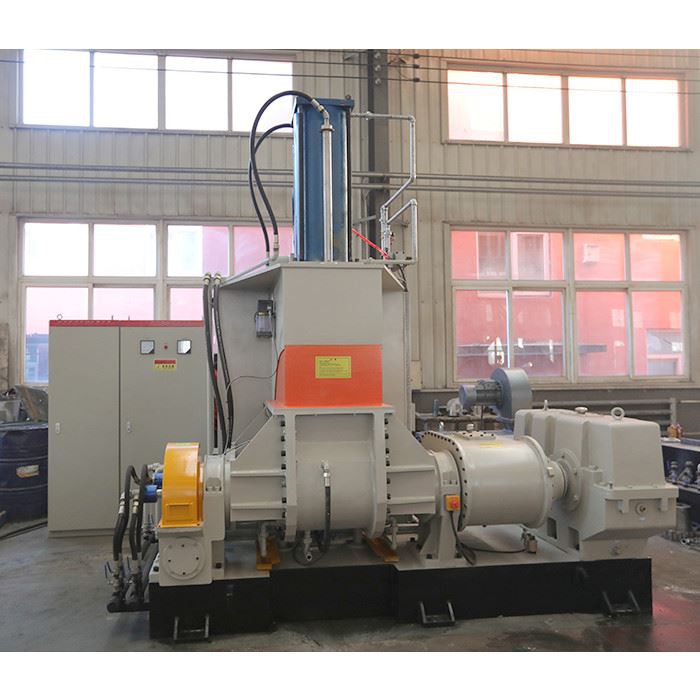
The basic structure of a banbury mixer consists of a mixing chamber, two rotors, a ram, and a discharge door. The mixing chamber is where all the action happens. It's a closed space where the raw materials are loaded and mixed. The two rotors are the heart of the mixer. They rotate in opposite directions, creating a shearing and kneading action that helps to break down the raw materials and mix them together.
The ram is used to apply pressure on the materials inside the mixing chamber. This pressure helps to ensure that the materials are in close contact with the rotors and each other, which improves the mixing efficiency. The discharge door is located at the bottom of the mixing chamber. Once the mixing process is complete, the discharge door opens, and the mixed compound is discharged from the mixer.
Now, let's dive into the mixing principle in more detail. When the raw materials are loaded into the mixing chamber, the rotors start to rotate. As they rotate, they create a complex flow pattern inside the chamber. The materials are first caught between the rotors and the chamber walls. The shearing force generated by the rotating rotors breaks down the large particles of the raw materials into smaller ones.
This shearing action is crucial because it helps to disperse the fillers and additives evenly throughout the rubber or plastic matrix. For example, if you're mixing carbon black (a common filler in rubber) with natural rubber, the shearing force will break up the carbon black agglomerates and distribute them uniformly in the rubber. This results in a compound with consistent properties, such as improved strength and abrasion resistance.
In addition to shearing, the rotors also create a kneading action. The kneading action helps to fold and blend the materials together. It's like kneading dough when you're making bread. The continuous folding and blending ensure that all the components are thoroughly mixed.
The pressure applied by the ram also plays an important role in the mixing process. The pressure forces the materials to fill the gaps between the rotors and the chamber walls, which increases the contact area and the shearing and kneading effects. Moreover, the pressure helps to expel any air bubbles that may be trapped in the materials during the loading process. Air bubbles can cause defects in the final product, so it's important to get rid of them.
Another factor that affects the mixing quality is the temperature. During the mixing process, a significant amount of heat is generated due to the friction between the materials and the rotors. This heat can be both beneficial and detrimental. On one hand, the heat can help to soften the rubber or plastic, making it easier to mix. On the other hand, if the temperature gets too high, it can cause the rubber to degrade or the additives to react prematurely.

To control the temperature, most banbury mixers are equipped with a cooling system. The cooling system can use water or other cooling media to remove the excess heat from the mixing chamber. By maintaining the right temperature, we can ensure that the mixing process is efficient and the quality of the final compound is high.
The mixing time is also an important parameter. The mixing time depends on several factors, such as the type and amount of raw materials, the desired degree of mixing, and the speed of the rotors. Generally, a longer mixing time will result in a more homogeneous compound. However, there's a limit to how long we can mix. If the mixing time is too long, it can lead to over - mixing, which can damage the polymer chains and reduce the quality of the compound.
Now, let's talk about some of the advantages of using a banbury mixer. One of the biggest advantages is its high mixing efficiency. The closed - chamber design and the powerful shearing and kneading actions allow the banbury mixer to mix large quantities of materials in a relatively short time. This makes it ideal for industrial production.
Another advantage is its ability to produce high - quality compounds. The uniform dispersion of fillers and additives achieved by the banbury mixer results in compounds with consistent physical and chemical properties. This is very important for applications where the performance of the final product is critical, such as in the automotive and aerospace industries.
However, like any other machine, banbury mixers also have some limitations. For example, they are relatively expensive to purchase and maintain. The complex design of the mixer requires skilled operators to operate and maintain it properly. Also, the cleaning of the mixing chamber can be a time - consuming process, especially when switching between different types of materials.
If you're in the rubber or plastics industry, you might also be interested in some related equipment. For instance, a Rubber Batch Off Unit is used to cool and transport the mixed rubber compound after it's discharged from the banbury mixer. A Kneader Machine For Rubber Mixing can be used for smaller - scale mixing or for materials that require a different type of mixing action. And an Open Mill is often used for final refining and calendering of the rubber compound.
In conclusion, the banbury mixer is a powerful and versatile machine for mixing rubber and plastic materials. Its unique mixing principle, based on shearing, kneading, and pressure application, allows it to produce high - quality compounds efficiently. If you're looking for a reliable banbury mixer for your production needs, don't hesitate to contact us. We can provide you with detailed information about our products and help you choose the right one for your specific requirements. Whether you're a small - scale manufacturer or a large - scale industrial enterprise, we've got the solution for you. Let's start a conversation and see how we can work together to improve your production process.
References:
- "Rubber Technology" by Maurice Morton
- "Plastics Mixing and Compounding" by James F. Carley