
In the realm of rubber processing, choosing the right equipment is crucial for ensuring high - quality products, efficient production, and cost - effectiveness. As a supplier of Rubber Batch Off Units, I've had the opportunity to closely observe how this equipment compares with other commonly used rubber processing machines. In this blog, I'll delve into the unique features, advantages, and limitations of the Rubber Batch Off Unit in comparison to other key players in the field, such as the Rubber Open Mill, New Type Banbury Mixer, and Rubber Mixing Line.

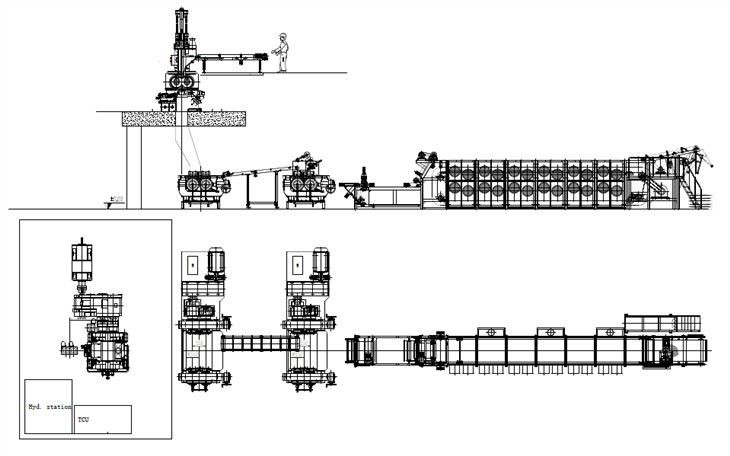
1. Understanding the Rubber Batch Off Unit
A Rubber Batch Off Unit is primarily used for cooling and stacking rubber compounds after they have been mixed. It consists of a series of rollers that transport the rubber sheet at a controlled speed, allowing it to cool down effectively. The cooled rubber sheet is then neatly stacked for further processing or storage. This unit is an essential part of the rubber manufacturing process, especially when dealing with large - scale production.
2. Comparison with Rubber Open Mill
The Rubber Open Mill is one of the oldest and most widely used rubber processing machines. It consists of two horizontally placed rollers that rotate at different speeds. The main function of a Rubber Open Mill is to mix rubber compounds, plasticize raw rubber, and disperse additives evenly.
- Mixing vs. Cooling and Stacking: The most obvious difference is the function. While the Rubber Open Mill is focused on the mixing process, the Rubber Batch Off Unit is designed for post - mixing tasks. The Open Mill can handle various types of rubber materials, including natural rubber, synthetic rubber, and their blends, and can achieve a high degree of dispersion of fillers and additives. In contrast, the Batch Off Unit is more about handling the mixed rubber sheet, ensuring it cools properly and is stacked in an organized manner.
- Operational Complexity: The Rubber Open Mill requires a certain level of skill to operate. The operator needs to control the gap between the rollers, the speed ratio, and the feeding rate to achieve the desired mixing effect. On the other hand, the Rubber Batch Off Unit is relatively easier to operate. Once the speed and tension are set, it can run continuously with minimal supervision.
- Production Capacity: In terms of production capacity, the Open Mill usually has a limited batch - mixing capacity. It is suitable for small - to medium - scale production or for research and development purposes. The Rubber Batch Off Unit, however, can handle large - volume production. It can work in tandem with high - capacity mixing machines, ensuring a smooth flow of the rubber sheet from the mixing stage to the cooling and stacking stage.
3. Comparison with New Type Banbury Mixer
The New Type Banbury Mixer is a high - intensity internal mixer. It consists of a mixing chamber with two rotors that rotate in opposite directions, providing a powerful shearing and mixing action.
- Mixing Intensity: The New Type Banbury Mixer offers a much higher mixing intensity compared to the Rubber Batch Off Unit. It can quickly and efficiently mix large quantities of rubber compounds, with a shorter mixing time. The Batch Off Unit, as mentioned earlier, is not involved in the mixing process but rather in the subsequent cooling and stacking steps.
- Energy Consumption: The Banbury Mixer consumes a significant amount of energy due to its high - power rotors and the need to maintain the temperature inside the mixing chamber. In contrast, the Rubber Batch Off Unit has relatively low energy consumption, mainly for driving the rollers and the cooling system.
- Material Handling: The Banbury Mixer requires careful handling of raw materials during the feeding process. Different materials need to be added in a specific sequence to ensure proper mixing. The Rubber Batch Off Unit, once the rubber sheet is fed in, mainly focuses on the physical handling of the sheet, such as transporting, cooling, and stacking.
4. Comparison with Rubber Mixing Line
A Rubber Mixing Line is a comprehensive system that integrates multiple rubber processing machines, including mixers, extruders, and Batch Off Units. It is designed to provide a continuous and automated rubber processing solution.
- System Integration: The Rubber Mixing Line is a complete system that can handle the entire rubber processing cycle from raw material input to the final product output. The Rubber Batch Off Unit is just one component of this line. While the Mixing Line offers a high level of automation and integration, the Batch Off Unit can also be used independently or as part of a custom - made production setup.
- Flexibility: The Rubber Batch Off Unit provides more flexibility in terms of installation and operation. It can be easily added to an existing production line or used in a small - scale production environment. The Rubber Mixing Line, although highly efficient for large - scale production, may require a significant investment in terms of space, equipment, and initial setup.
- Cost - effectiveness: For small - to medium - scale producers, the Rubber Batch Off Unit may be a more cost - effective option. It can perform its specific function without the need for a large - scale integrated system. The Rubber Mixing Line, on the other hand, is more suitable for large - scale manufacturers who require high - volume production and a high degree of automation.
5. Advantages of the Rubber Batch Off Unit
- Improved Product Quality: By ensuring proper cooling of the rubber sheet, the Rubber Batch Off Unit helps to maintain the physical and chemical properties of the rubber compound. This leads to a more consistent and high - quality final product.
- Increased Production Efficiency: The continuous operation of the Batch Off Unit allows for a smooth flow of the rubber sheet from the mixing stage to the next process. This reduces downtime and increases overall production efficiency.
- Space - saving: Compared to some other large - scale rubber processing equipment, the Rubber Batch Off Unit has a relatively compact design, which is beneficial for factories with limited space.
6. Limitations of the Rubber Batch Off Unit
- Single - Function: As mentioned earlier, the Batch Off Unit is mainly designed for cooling and stacking rubber sheets. It cannot perform mixing or other rubber processing tasks on its own.
- Dependence on Upstream Equipment: Its performance is highly dependent on the quality and output of the upstream mixing equipment. If the rubber compound is not properly mixed, the Batch Off Unit may not be able to achieve the desired cooling and stacking results.
7. Conclusion and Call to Action
In conclusion, the Rubber Batch Off Unit plays a vital role in the rubber processing industry. While it has its own unique advantages and limitations, it complements other rubber processing equipment such as the Rubber Open Mill, New Type Banbury Mixer, and Rubber Mixing Line. Whether you are running a small - scale rubber production facility or a large - scale manufacturing plant, choosing the right combination of equipment is essential for achieving optimal production results.
If you are in the market for a high - quality Rubber Batch Off Unit, we are here to help. Our units are designed with the latest technology, ensuring efficient cooling and stacking of rubber sheets. We offer a range of models to meet different production requirements. Contact us to discuss your specific needs and start a procurement negotiation. We look forward to working with you to enhance your rubber processing capabilities.
References
- Smith, J. (2018). Rubber Processing Technology. Elsevier.
- Brown, A. (2020). Advances in Rubber Mixing Equipment. Journal of Rubber Science and Technology.
- Chen, L. (2021). Optimization of Rubber Production Processes. Springer.